


If you are running a manufacturing shop contracting with outside OEMs, there's no question you've got your processes well defined. It's the only way to stay profitable. To have success winning aviation manufacturing jobs — any job where the product comes under the purview of the Federal Aviation Administration (FAA) — having good internal processes isn't enough. Successful shops need to evolve their processes developed from other manufacturing sectors so they align with the requirements driving aviation manufacturing.
A central element affecting the processes for manufacturing in aviation is something the FAA designates as a "Work Product." Adapting your shop's processes to account for proper handling of Work Product is going to help make it easier for you to pursue work from any customer in the whole Aerospace and Defense industry.
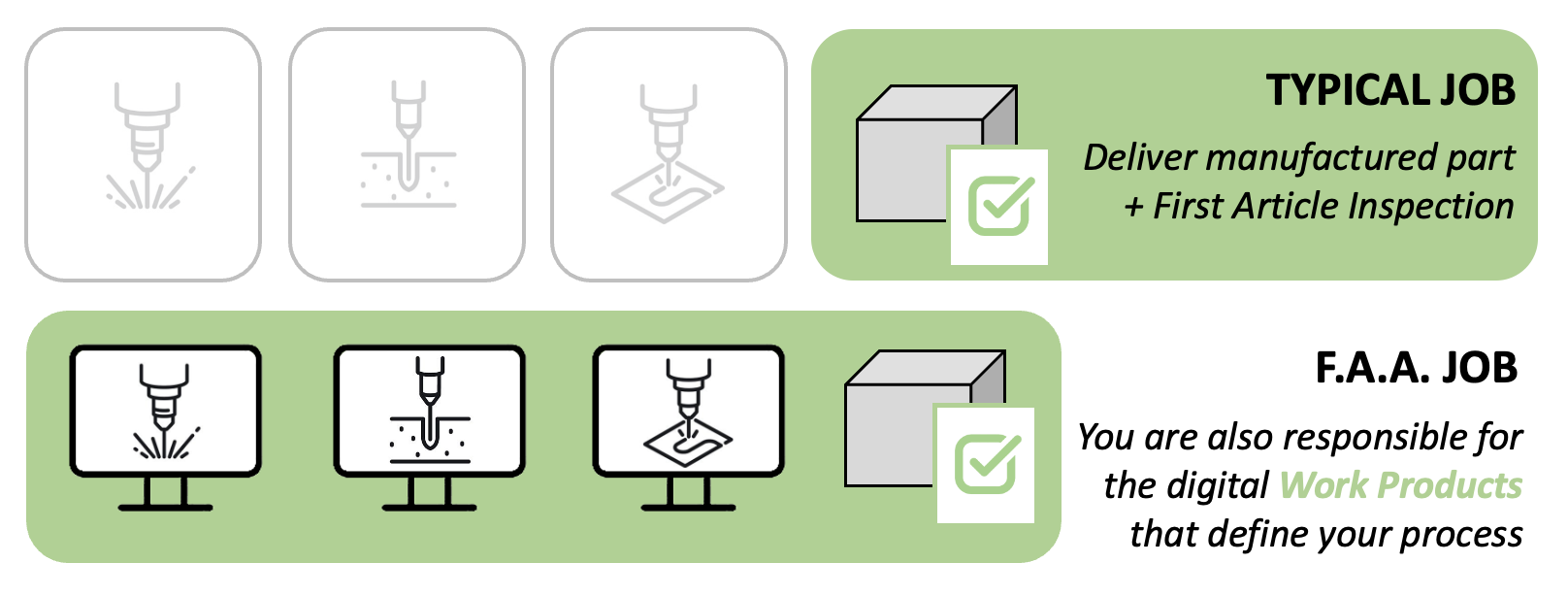
What is Work Product as defined by the FAA?
According to the FAA AMS Lifecycle Verification and Validation Guidelines Section 1.2.1 (version 3.0, April 2017): A Work Product represents, defines, or directs the final product. This includes any significant documents, process diagrams, models, drawings, specifications, etc. In modern manufacturing, that almost always means 3D digital data is a Work Product. Notably, this pertains to more than the 3D design authority CAD data: Work Product is also generated when the customer-supplied data is fed into the systems that make up the manufacturing process.These include:
- Designing tooling
- Designing fixtures
- Generating NC programs
- Managing digital inspection & metrology
A shift in perspective
At first glance, it might seem that adding the designation of "Work Product" to steps you routinely take on any job (generating NC paths, etc.) is just a matter of semantics. But it is more than that: it's a recognition that the 3D data files generated by engineers during the manufacturing process has as much to do with the ultimate effectiveness of producing aerospace components as the original, client-supplied model. It also expands the responsibilities of the manufacturer for confirming accurate outcomes beyond just the customary First Article Inspection reporting to include additional in-process records and data checks.
It is understood that all contemporary shops have refined their processes in order to efficiently deliver accurate parts — the "what" of contract manufacturing. However, incorporating the principle of Work Product will help you document, communicate, and archive the "how" of what your shop produces. For aerospace manufacturing, this is a vital component of ensuring aircraft safety and reliability: these factors are included in any review when a safety incident occurs.
The FAA's Verification and Validation standards
The FAA Verification and Validation guidelines make clear that technical evaluations must not be limited to only the final inspection of a produced part, but that technical evaluations must occur throughout the entire product lifecycle. This has been a component of the guidelines for more than twenty years. Once you recognize that the stages of your process generate their own Work Product — the precise 3D data you feed into your manufacturing and inspection equipment — it becomes clear that the quality check process can't only be applied to the final manufactured part. Meeting the requirements of manufacturing in FAA-overseen sectors will require you to develop a quality check process for Work Product at every stage. In the terminology of the FAA, these in-process confirmations of 3D data accuracy fall under the same process guidelines as all inspection, referred to as Verification & Validation, or V&V for short.
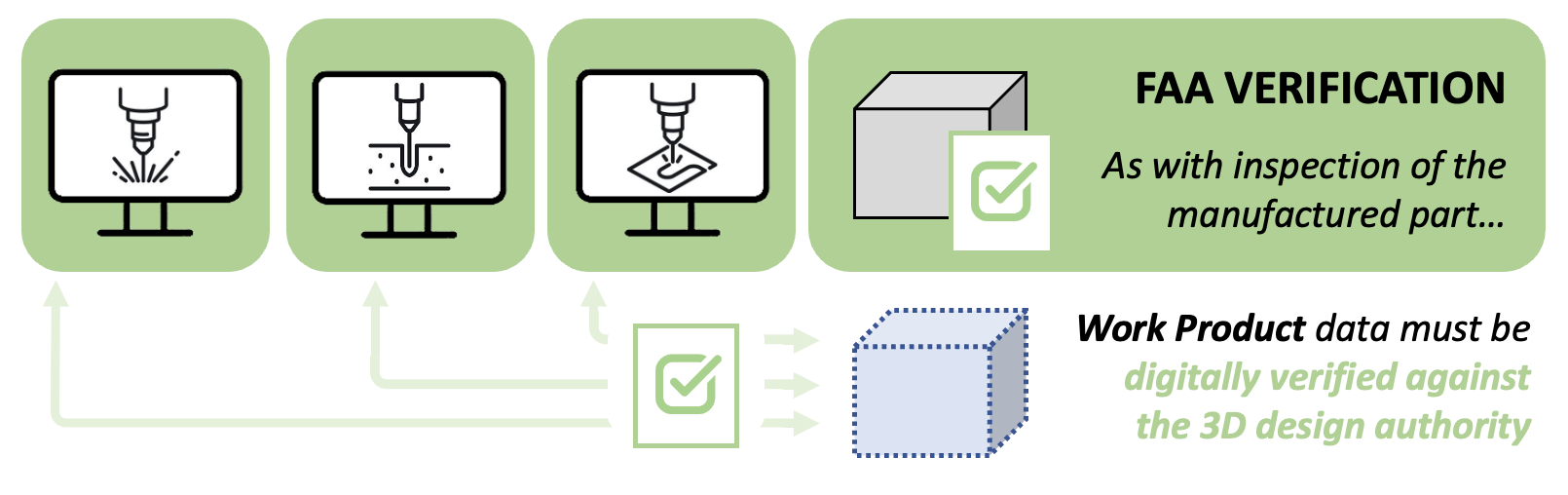
Any exchange of 3D data between systems should be verified
When a supplier receives a 3D CAD model from an aircraft OEM, that model is typically referred to as the Authority CAD data. It represents the customer’s official definition of the part. In a typical manufacturing setting, the only truly meaningful evaluation of how well the manufacturer has maintained fidelity to that definition is made with the produced parts are passed by inspection. However, in an FAA-regulated segment, demonstrating that the definition has been maintained must take place for each Work Product involved in the manufacturing process, not merely the final, physical produced part.
Each time the Authority CAD data is:
- Imported into a different CAD or CAM system
- Translated into another file format
- Read into software with a different underlying database
...it becomes a new, intermediate Work Product, often called Derivative CAD data. According to FAA guidelines, every one of these transformations is a Verification & Validation (V&V) Event:
“All critical work products, product components, and products, including those used as V&V criteria, are subject to systematic V&V by various program disciplines during every activity/phase of the lifecycle.” (Introduction, Section 3, V&V Approach in the AMS Lifecycle)
A common example is when OEM Authority data—often created in a customer’s primary CAD system—is translated into the CAD/CAM platform used by the supplier across all of its jobs. Even if the translation uses an industry-standard format like STEP, it still represents a new Work Product that must be verified. Though the variables in how different software systems interpret 3D data are subtle, a certain chance for error is introduced every time the data moves between systems. The incorporation of V&V evaluations during the manufacturing process is a natural extension of the FAA's commitment to reducing risk.
As stated in Section 2.2 of the V&V guidelines: “Critical technical documents that form the basis for future work products, product components, or products during a program’s lifecycle must be verified and validated before their use in all subsequent processes including the V&V process.”
What this means for the aviation parts supplier
Aligning your shop with the requirements of industries regulated by the FAA can position you for future success. You will show prospective customers in this sector that you are informed and prepared for these rigorous standards. You won't be competing only on price, but also on demonstrated capabilities.
Tools to simplify how you maintain 3D data accuracy
You've got solid processes already in place. You don't want to disrupt what has been working so well for you as you consider bringing FAA-governed jobs into your shop. The good news is that there are tools such as our Validate and Revision file utilities that simplify how you document your 3D Work Product V&V events and ensure yourself and your clients that proper fidelity has been maintained. When you are ready to take a deeper dive into what it means to make your shop ready for aerospace work and other model-based initiatives, our team will be glad to answer your questions.
- Share
-